

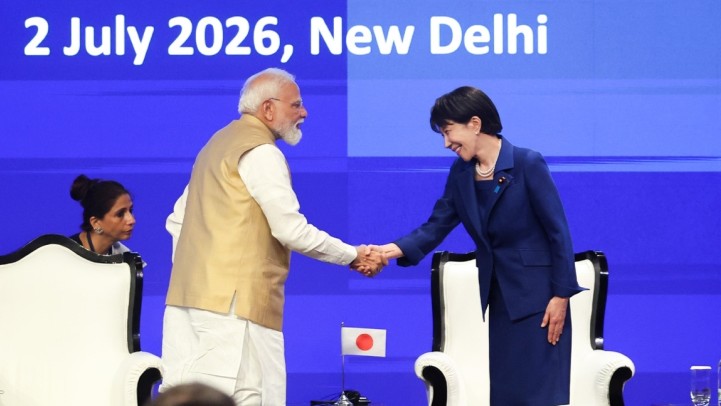
India and Japan adopted a joint statement on India-Japan energy resilience in New Delhi on 2 July 2026, with the Ministry of Petroleum and Natural Gas of the Republic of India and Japan’s Ministry of Economy, Trade and Industry agreeing to cooperate on strategic stockpiling, energy supply security, maritime transport and institutional dialogue.
NEW DELHI, 2 July 2026: The statement followed talks between the Prime Minister of India, H.E. Shri Narendra Modi, and the Prime Minister of Japan, H.E. Ms Takaichi Sanae, during the 16th India-Japan Annual Summit. The two leaders met in New Delhi and described India and Japan as responsible powers and major energy-consuming countries in Asia.
The two governments said they intended to strengthen energy resilience in light of the current geopolitical situation. The agreement places energy security within the wider India-Japan Special Strategic and Global Partnership, which both sides are seeking to expand across economic security, technology, clean energy and supply chains.
The joint statement identifies strategic stockpiling as a central area of cooperation. Both sides agreed to share knowledge and experience on national stockpiling systems, reserve mechanisms for crude oil and petroleum products, and industry stockpiles.
The two ministries will also examine coordination with producing countries, emergency response systems and market stabilisation mechanisms. The focus reflects concerns among major energy-consuming economies over price volatility, supply disruption and the need for predictable access to oil and gas.
The statement also seeks to strengthen the voice of energy-consuming countries. India and Japan agreed to cooperate on energy availability and affordability through supply assurance, resilience-building and mechanisms to mitigate volatility.
Planned cooperation includes information-sharing on market trends and joint efforts to support market stability. The two sides will also explore energy supplies from third countries and possible commercial engagements for upstream investments in third countries.
Energy transport is another major pillar of the statement. The two governments reaffirmed the importance of resilient, self-reliant and efficient maritime transport of oil and gas. They also agreed to explore collaborative opportunities, including joint investments, across the maritime energy transport value chain.
The broader summit statement linked this agenda to freedom of navigation and uninterrupted global commerce. It referred specifically to the Strait of Hormuz and opposed restrictive measures that hamper the movement of commercial vessels.
Both governments also highlighted regional energy resilience initiatives. These include India’s support for energy security in South Asia and Japan’s Partnership On Wide Energy and Resources Resilience Asia, known as POWERR Asia. The summit statement also referred to the Quad Initiative on Indo-Pacific Energy Security.
Institutional cooperation will involve relevant Indian and Japanese entities. On the Indian side, the statement names Indian National Oil Companies and Indian Strategic Petroleum Reserves Limited. On the Japanese side, it names the Japan Organization for Metals and Energy Security and the Japan Bank for International Cooperation.
The two sides will take the agenda forward through the India-Japan Joint Working Group on Petroleum and Natural Gas. The mechanism will operate under the India-Japan Energy Dialogue and will be used to share current knowledge, review experience and explore mutually beneficial opportunities.
The Ministry of External Affairs listed the energy resilience statement among 16 outcomes from Prime Minister Takaichi’s visit to India. Other outcomes included agreements or cooperation documents on economic security, artificial intelligence, biogas, batteries, pharmaceuticals and medical devices, critical minerals, next-generation mobility, financial services and research partnerships.
Japan’s Ministry of Foreign Affairs said Prime Minister Takaichi held a leaders’ meeting with Prime Minister Modi on 2 July during her visit to Delhi. It said the two sides announced outcome documents and that the leaders concurred to launch a bilateral dialogue under POWERR Asia towards India’s petroleum and oil reserve in the field of energy security.
Prime Minister Takaichi also affirmed Japan’s support for India’s participation in the International Energy Agency, according to the India-Japan Annual Summit joint statement. The statement said Japan attached importance to India’s role in stabilising the international energy market.
The energy resilience statement adds a strategic petroleum and transport dimension to India-Japan economic cooperation. Its next phase will depend on how the two ministries and designated institutions convert the agreed framework into reserve cooperation, investment opportunities and coordinated responses to energy market disruption.
Source: PM India
