

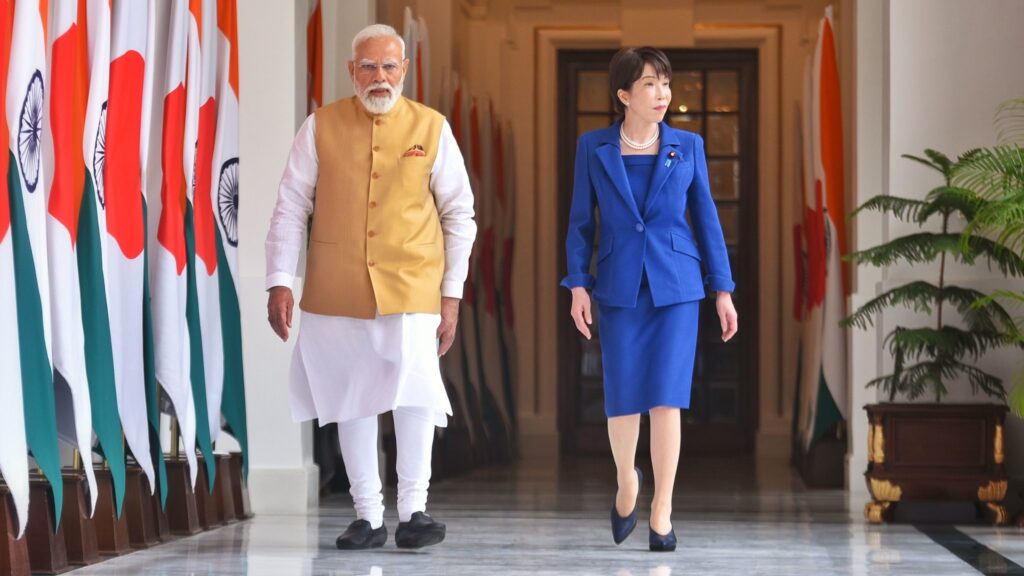
The India-Japan strategic partnership entered a new phase in New Delhi as Prime Minister Narendra Modi and Japanese Prime Minister Sanae Takaichi announced cooperation on artificial intelligence, defence technology, economic security, energy resilience, investment and next-generation mobility during the 16th India-Japan Annual Summit.
NEW DELHI, July 2: Prime Minister Narendra Modi on Thursday welcomed Japanese Prime Minister Sanae Takaichi on her first visit to India as Prime Minister, calling the bilateral relationship a partnership built on “friendship and trust”.
Speaking during the joint press statement after talks at Hyderabad House, Modi said India and Japan were beginning a new chapter in their Special Strategic and Global Partnership. He said mutual trust had become the most important strategic asset in an unsettled international environment.
Takaichi, Japan’s first woman Prime Minister, arrived in India for the 16th India-Japan Annual Summit from July 1 to 3. Her visit comes as New Delhi and Tokyo seek to deepen cooperation across technology, defence, supply chains, energy and people-to-people exchanges.
Modi said both countries shared a commitment to a “free, prosperous and rules-based Indo-Pacific”. He described India and Japan as major democratic and market economies whose cooperation could support peace, stability and progress across the region.
Technology was placed at the centre of the summit outcomes. Modi said he and Takaichi believed that technology partnership would become the strongest pillar of bilateral cooperation. The two sides issued a Joint Statement on Artificial Intelligence, while leading Indian AI institutions concluded agreements with Japanese partners.
Modi said the combination of Japan’s precision technology and India’s software capabilities could give fresh momentum to global AI development. The emphasis reflects wider efforts by both governments to build trusted technology partnerships in strategic and emerging sectors.
Defence cooperation also advanced with what Modi described as the first India-Japan co-development project in the defence sector. The project relates to a Naval Radio Antenna and is expected to open a new phase in defence technology cooperation between the two countries.
The Prime Minister said India and Japan would work together on defence technologies that support regional peace, maritime security and a rules-based order. The announcement is significant because both countries are members of the Quad, alongside the United States and Australia.
The two sides also agreed to expand cooperation in pharmaceuticals, medical devices and biotechnology. Modi said India’s scale and Japan’s quality standards could help deliver affordable, reliable and advanced health solutions for global markets.
Investment formed another major pillar of the summit. Modi said more than 100 new business agreements had been concluded over the past year, bringing more than $10 billion in Japanese investment to India.
He also said both governments would work towards attracting 10 trillion yen in Japanese investment into India over the next decade. New Delhi and Tokyo also aim to double the number of Japanese companies operating in India.
A separate agreement between financial services agencies is expected to ease capital and investment flows. Modi said India’s reform process had improved the ease of doing business and offered further opportunities for Japanese companies.
Economic security and energy security featured prominently in the discussions. The two sides prepared a Joint Roadmap on Economic Security, with a focus on resilient supply chains in semiconductors, quantum technologies and advanced materials.
Energy cooperation was expanded through the India-Japan Bio-gas Initiative. Modi said the initiative would support the establishment of 1,000 biogas and organic fertiliser plants in India and strengthen the Government of India’s GOBARdhan initiative.
The two countries also announced cooperation on energy resilience, batteries, green hydrogen and nuclear energy. Modi said India and Japan viewed economic security as shared security and energy transition as a shared opportunity.
The summit also produced the India-Japan Next Generation Mobility Partnership Framework. Modi said the framework would build on the success of bilateral cooperation in the automotive sector and extend it to shipbuilding, aviation and logistics.
People-to-people ties formed the final pillar of the statement. Modi said both governments were expanding opportunities in talent mobility, skilling and technical internship programmes. He also referred to cooperation in research, education and start-ups.
India and Japan will mark the 75th anniversary of diplomatic relations in 2027. Modi said both countries would use the milestone to strengthen ties in culture, tourism and the creative economy.
The summit reinforced the long-term convergence between New Delhi and Tokyo on technology, economic resilience, maritime security and regional stability. The next phase will depend on how quickly the announced frameworks and sectoral agreements translate into projects, investment flows and institutional cooperation.
Source: PM India
