

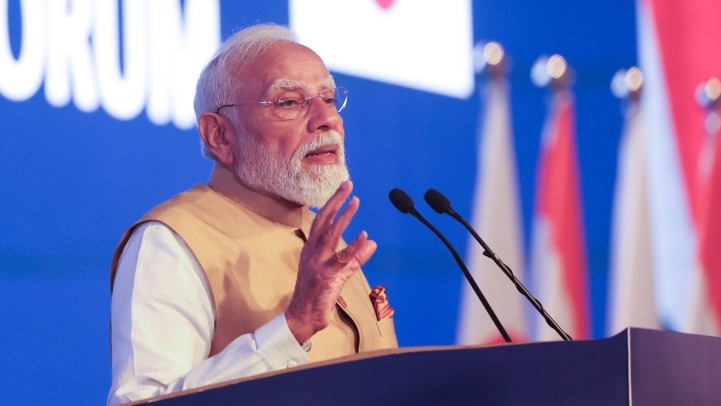
The Prime Minister of India, Shri Narendra Modi, addressed the India-Japan Business Forum in New Delhi on 2 July 2026, urging Japanese businesses to deepen investment in India and help build resilient partnerships in manufacturing, technology, clean energy, healthcare and strategic supply chains alongside the Prime Minister of Japan, H.E. Ms Takaichi Sanae.
NEW DELHI, 2 July 2026: Prime Minister Modi used the forum to present India as a long-term economic partner for Japanese companies at a time of global supply chain disruption, trade uncertainty and weaker demand. He said the India-Japan relationship remained “truly special” and pointed to decades of Japanese corporate engagement in India.
The address came during Prime Minister Takaichi’s official visit to India from 1 to 3 July 2026 for the 16th India-Japan Annual Summit. The summit produced a series of outcomes across economic security, artificial intelligence, energy resilience and other areas of bilateral cooperation.
Prime Minister Modi cited Maruti Suzuki’s new manufacturing plant at Kharkhoda in Haryana as an example of the scale of Japanese industrial participation in India. He said nearly two-thirds of Suzuki’s cars worldwide are manufactured in India and exported to more than 100 countries. He also referred to motorcycles made in India by Kawasaki, Yamaha and Honda being exported to global markets.
He argued that the combination of Japanese expertise and investment with India’s scale and speed could deliver wider global benefits. The sectors he mentioned included air conditioners, power grid equipment, precision manufacturing and medical technology.
The Prime Minister framed India’s economic position against a challenging international backdrop. He said India remained the world’s fastest-growing major economy and recorded 7.7 per cent GDP growth in the last financial year. He also said India had pursued reforms in taxation, governance and ease of doing business.
A key announcement was the proposed Japan Business Week, to be organised by the Prime Minister’s Office. Prime Minister Modi said senior PMO officials would engage directly with Japanese businesses, hear their concerns and discuss steps to improve ease of doing business for Japanese investors in India.
He also referred to the Japan Bank for International Cooperation survey, saying India had been ranked the most promising destination for Japanese businesses for the fourth consecutive year. The reference reinforced New Delhi’s message that Japanese industry should view India as a core investment destination for the next decade.
Prime Minister Modi said he and Prime Minister Takaichi had resolved to make the partnership “more dynamic and deeper”. He said the two sides had concluded agreements across economic security, artificial intelligence, defence and healthcare, describing the agenda as future-oriented.
The Prime Minister called on business leaders to convert the political vision into measurable outcomes. He said Japanese investment in India should not only meet but surpass the target of 10 trillion yen over the next decade. He also said the two countries should aim to double the number of Japanese companies operating in India during the same period.
Prime Minister Modi outlined a broader industrial vision linking Japan’s technology and capital with India’s market potential and ambition. He identified semiconductors, pharmaceuticals, critical minerals, shipbuilding, mobility, clean energy, artificial intelligence, quantum technologies and biotechnology as areas for deeper cooperation.
The artificial intelligence agenda also featured in a separate India-Japan joint statement. The two governments described AI as an era-defining technology and called for public-private partnerships involving corporations, start-ups, research institutions, investors and public agencies from both countries.
The business forum underscored the commercial dimension of the India-Japan Special Strategic and Global Partnership. With both governments now linking investment, innovation and economic security, the next phase of cooperation will depend on how quickly companies convert summit-level commitments into projects across manufacturing, technology and resilient supply chains.
Source: PM India
