

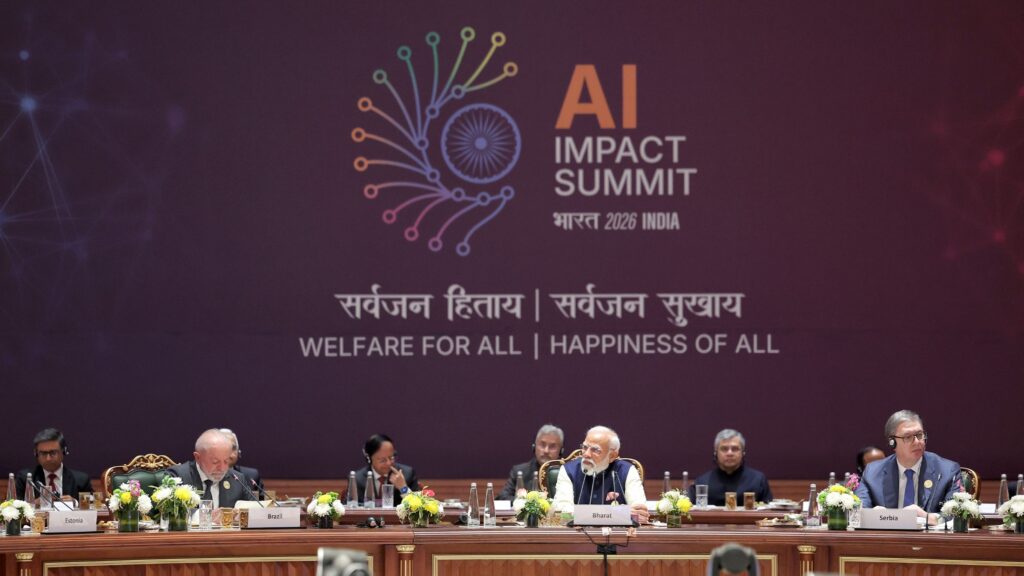
Prime Minister Narendra Modi calls for ethical, transparent and inclusive AI governance at Bharat Mandapam in New Delhi.
Prime Minister Narendra Modi delivered his remarks at the Leaders’ Plenary Session of the India AI Impact Summit 2026 held at Bharat Mandapam in New Delhi today.
Welcoming global leaders and delegates, the Prime Minister said the summit will help build a human-centric and sensitive global AI ecosystem. He stated that history shows humanity has always turned disruption into opportunity, and Artificial Intelligence presents a similar moment.
Quoting Lord Buddha’s teaching, “Right Action comes from Right Understanding,” the Prime Minister stressed the need for correct and timely decisions to ensure AI brings positive impact.
He recalled the global cooperation during the COVID-19 pandemic. He said that when countries worked together, they found solutions in vaccine development, supply chains, and data sharing. He highlighted India’s digital vaccination platform and the success of UPI in enabling seamless online transactions during difficult times. He noted that India has built a strong digital public infrastructure and is sharing it with the world. According to him, technology should empower, not dominate.
The Prime Minister said AI must be accessible to all and not create new divisions. He emphasized that the priorities of the Global South must be placed at the center of AI governance discussions.
Speaking about ethics, Shri Modi warned that while AI offers great possibilities, its misuse can also be unlimited. He said ethical norms must be equally strong and limitless. He urged AI companies to align profit with purpose and take responsibility for the social impact of their technologies. He noted that AI is already influencing human learning, thinking, and emotions.
The Prime Minister outlined three key suggestions for ethical AI use:
First, AI training must respect data sovereignty and follow a trusted global data framework. He reminded the audience of the principle “garbage in, garbage out,” stressing that unreliable data leads to unreliable outcomes.
Second, AI platforms must adopt transparent safety rules. He called for a “glass box” model instead of a “black box,” where systems are open to verification and accountability.
Third, AI must be guided by human values. He referred to the “paper clip problem” to explain how machines without clear ethical direction can misuse resources. He underlined that technology is powerful, but humans must decide its direction.
The Prime Minister also spoke about India’s AI Mission. He announced that 38,000 GPUs are currently available in India, and 24,000 more will be added within six months. He said startups are receiving world-class computing power at affordable rates.
He highlighted AIKosh, India’s National Dataset Platform, which has shared more than 7,500 datasets and 270 AI models as national resources.
Concluding his remarks, the Prime Minister said AI is a shared resource for the welfare of humanity. He emphasized that innovation, inclusion, and human values must move together. He said when technology and human trust combine, AI will bring real and positive change across the world.
Source: PMO
