

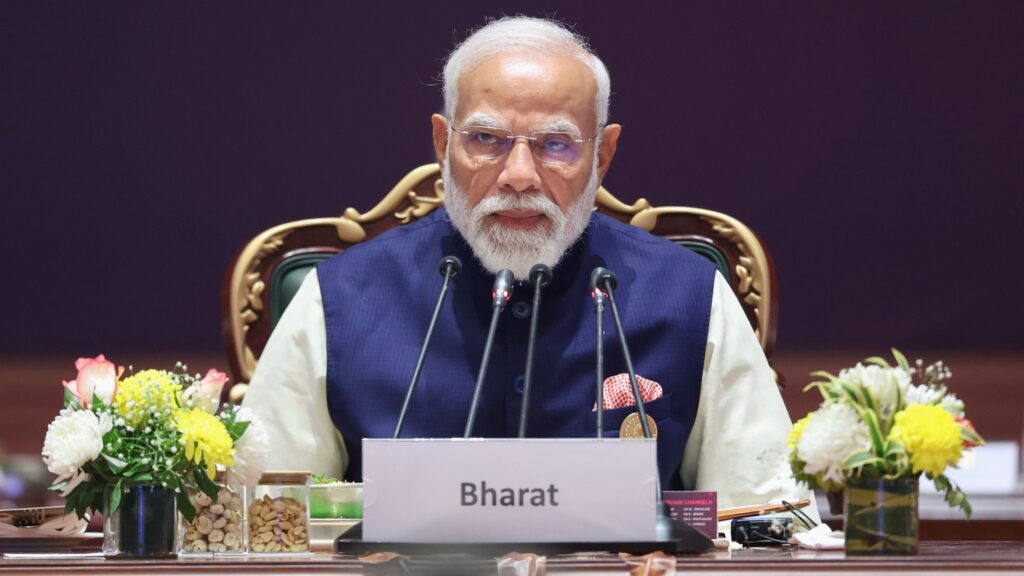
Prime Minister Narendra Modi outlines roadmap for ethical and inclusive AI at India AI Impact Summit 2026 in New Delhi.
Prime Minister Narendra Modi delivered his remarks at the Leaders’ Plenary Session during the India AI Impact Summit 2026 in New Delhi.
Welcoming global leaders and delegates, the Prime Minister said he is confident that the summit will play an important role in building a human-centric and sensitive global AI ecosystem. He said history shows that humanity has always turned disruptions into opportunities, and today the world must convert the disruption caused by Artificial Intelligence into the greatest opportunity for humanity.
Referring to Lord Buddha’s teaching, “Right Action Comes from Right Understanding,” the Prime Minister stressed the need for a clear roadmap. He said AI will have the right impact only when decisions are taken at the right time, with the right intention.
He recalled the global cooperation during the COVID-19 pandemic. He said that from vaccine development to supply chains and data sharing, collaboration helped save lives. He highlighted India’s digital vaccination platform that enabled timely vaccination of millions. He also mentioned UPI, which ensured smooth online transactions even in difficult times and helped bridge the digital divide.
The Prime Minister said India has built a strong digital public infrastructure and is sharing it with the world. According to him, technology is not a tool of power, but a tool of service. He said AI must also move in this direction and serve the welfare of humanity.
He stressed that in the past, technology created divisions. Now, AI must be accessible to everyone. He said the aspirations and priorities of the Global South must be placed at the center of AI governance discussions.
Speaking about ethics, the Prime Minister said that while unethical behavior was limited in earlier times, in the AI era its scope is unlimited. Therefore, ethical norms must also be unlimited. He said AI companies have a big responsibility to focus not only on profit but also on purpose. He added that AI is already influencing human learning, intelligence, and emotions.
The Prime Minister offered three key suggestions for ethical AI use:
First, AI training must respect data sovereignty and follow a trusted global data framework. He referred to the principle “garbage in, garbage out,” saying unreliable data leads to unreliable results.
Second, AI platforms must keep safety rules clear and transparent. He called for a “glass box” approach instead of a “black box,” where safety rules can be seen and verified. This, he said, will ensure accountability and ethical business practices.
Third, AI must be guided by clear human values. He mentioned the “paper clip problem” to explain how machines, if given only one goal, may use unlimited resources to achieve it. He stressed that while technology is powerful, direction must always be decided by humans.
Highlighting India’s role in the global AI journey, the Prime Minister said that under India’s AI Mission, 38,000 GPUs are already available and 24,000 more will be added in the next six months. He said startups are being provided world-class computing power at affordable rates.
He also mentioned AIKosh, through which more than 7,500 datasets and 270 AI models have been shared as national resources.
Concluding his address, the Prime Minister said India’s vision is clear—AI is a shared resource for the welfare of humanity. He emphasized that innovation, inclusion, and human values must move forward together. He said when technology and human trust walk together, the true impact of AI will be visible across the world.
Source: PMO
